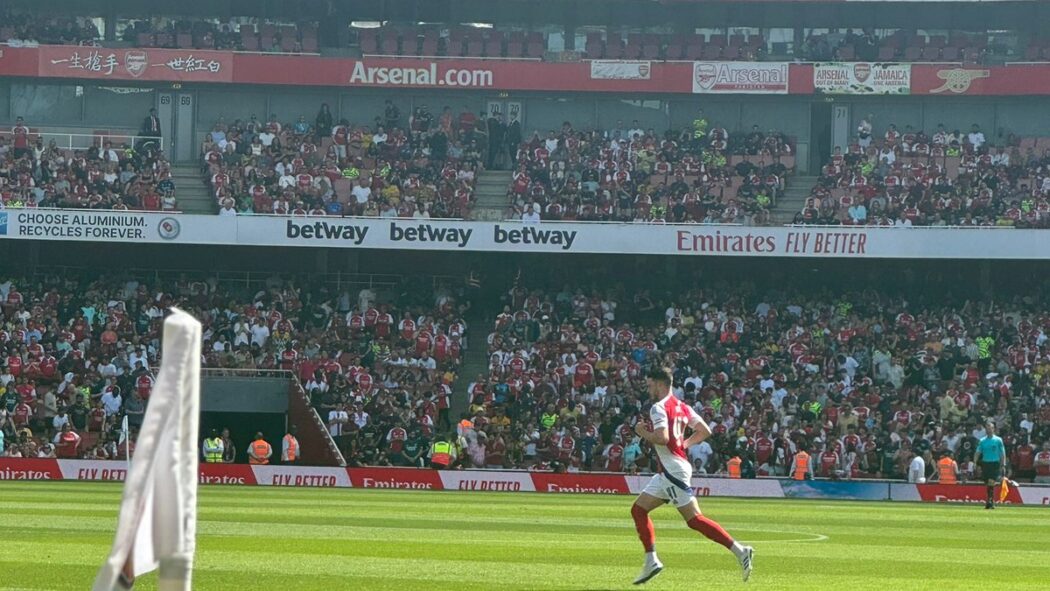
Graeme Souness has long had doubts about Declan Rice.
His latest criticism, delivered on the first episode of Piers Morgan and Simon Jordan’s new Football Uncensored show, has brought that long-running argument back into focus.
Souness believes Rice spends too much time dropping out of midfield during Arsenal’s build-up. He pointed to occasions when the England international moves between the centre-backs, or into the space between a centre-back and full-back, to collect possession with relatively little pressure on him.
For Souness, that is not what an elite central midfielder should be doing.
He described it as “old man’s football” and argued that receiving the ball in those areas allows Rice to take the easier option rather than influencing the game from midfield. He even suggested that Rice might ultimately be better suited to centre-half. Goal.com reported the exchange.
It is a striking judgement about a player who has just helped Arsenal win the Premier League. But there is a football argument behind it.
The question is whether Souness has identified a limitation in Rice’s game or simply a feature of how a modern midfielder is being asked to play.
What Souness is actually arguing
The language is provocative, but Souness’s argument is more nuanced than it first appears.
His point is that the hardest place for a midfielder to receive the ball is in midfield itself. There are opponents behind you, pressure can arrive from several directions and the next pass often has to be made quickly.
Dropping alongside a centre-back changes that.
A player can face the pitch, receive under less pressure and recycle possession. Souness argues that Rice does this too often and therefore does not dictate matches from central areas in the way the very best midfielders do.
“It’s old man’s football. It’s cheating.”
Souness nevertheless described Rice as the best defensive midfielder in the country because of his ability to recognise danger. His criticism is primarily about what happens when Arsenal have the ball.
Piers Morgan, an Arsenal supporter, challenged Souness during the discussion. One response on X summed up the exchange: “Imagine trying to argue with SOUNESS about what makes a midfielder…”
Watch the Football Uncensored discussion on YouTube
Nor is Souness’s position new.
Back in 2023, he argued that a top midfielder had to excel defensively, create and score, and that Rice was outstanding in only the first of those areas.
Rice called the assessment “harsh”, while still acknowledging Souness’s standing as one of the outstanding midfielders of his generation. He suggested Souness did not see enough of his performances for West Ham to judge the full range of his game.
Three years later, Souness has not changed his mind.
Rice, however, has developed considerably as a player.
The centre-half argument is difficult to sustain
There is some history behind Souness’s suggestion that Rice could be a defender.
Rice did spend a season playing at centre-back in West Ham’s academy. Mark Phillips, his former youth coach, has recalled that Rice enjoyed being able to see the game in front of him and excelled there before moving back into midfield.
The Premier League’s recent profile of Rice explains how that period in defence helped develop the awareness that later became one of his strengths in midfield.
That background helps explain why Rice can look so comfortable when he drops into Arsenal’s defensive line.
It does not establish that he belongs there.
Rice’s numbers from last season point strongly in the other direction.
Rice was voted the club’s Player of the Season for the second successive year after Arsenal won their first Premier League title in 22 years and reached the Champions League final.
He received 44 per cent of the supporters’ vote. Across all competitions he scored five goals, provided nine assists and created 96 chances. He also regained possession 239 times and made 91 tackles, leading Arsenal in all three of those latter categories.
Those figures come from Arsenal’s own Player of the Season review.
Those numbers are difficult to square with the idea that Rice is simply taking the easy option.
A player can accumulate safe passes from deep. It is considerably harder to explain away a midfielder who leads a title-winning side both for creating chances and winning possession.
That is not the statistical profile of a centre-half playing in the wrong position.
Rice does much more than recycle possession
There is also evidence that directly challenges the suggestion that Rice receives the ball cheaply and then simply moves it sideways.
One of the clearest examples came against Newcastle last season.
Opta Analyst described Rice as the “complete midfielder” after a performance at St James’ Park in which he led every player on the pitch for touches, completed passes, passes into the final third, line-breaking passes, crosses and carries.
He had 105 touches, completed 75 passes, made 17 line-breaking passes and carried the ball 29 times. He was also joint-top for chances created, tackles and possessions won.
One match cannot settle an argument about a player, but it does show what Rice is capable of.
The line-breaking passes are particularly relevant to Souness’s criticism. A midfielder repeatedly bypassing opposition lines with his passing is doing considerably more than collecting possession from a centre-back and returning it sideways.
Rice’s carrying is important too. He has become increasingly effective at advancing Arsenal through the pitch himself rather than simply passing possession onwards.
Why does Rice drop so deep?
This is where Souness’s argument becomes more complicated.
Souness sees a midfielder dropping into the defensive line and asks why he is not demanding the ball further forward.
In modern positional football, the question is different: what does his movement do to the opposition?
If a midfielder drops between centre-backs, an opponent has a decision to make. Follow him and potentially leave space elsewhere. Stay in midfield and allow him possession.
That movement can create a temporary back three, change the angle of the build-up or allow another Arsenal player to move higher up the pitch.
The starting position alone therefore tells us relatively little.
Full-backs now move into central midfield. Centre-backs step beyond midfielders. Holding midfielders drop into the defensive line. A player can occupy several different positions during the same passage of possession.
Rice’s versatility is one of the reasons Arsenal value him so highly. The club itself highlighted his ability to operate either in front of the defence or closer to the attack when announcing him as Player of the Season.
If Mikel Arteta is asking Rice to drop into the first line of possession as part of that structure, it would be difficult to treat his presence there automatically as an attempt to avoid responsibility.
The better question is what Rice does after receiving the ball. Does he simply give it back, or does he draw an opponent, carry forward or find a player between the lines? And does Arsenal’s shape improve because he has moved?
Those are better measures of his performance than his starting position alone.
Souness still raises a fair question
That does not mean Souness should simply be dismissed as a former player who does not understand modern football.
There remains a legitimate question about whether Rice can become even more influential in possession.
The very best midfielders want the ball when the pitch is crowded and the passing angles are difficult. Rodri has demonstrated that repeatedly at Manchester City. So did many of the great midfielders of recent years.
It is reasonable to ask whether Rice dictates the tempo of a match with quite the same authority.
It is also reasonable to examine how often he receives possession ahead of the opposition’s first line rather than behind it.
But those are questions about the limits of an outstanding midfielder. They are different from concluding that he is really a centre-half.
Rice has developed significantly since Souness first criticised him three years ago. His chance creation has improved. His set-piece delivery has become a major weapon. His ball carrying has become increasingly important, while his ability to recover possession remains one of his strongest qualities.
There are midfielders who pass better than Rice, create more or control the rhythm of games more naturally. Very few combine those qualities with his defensive awareness, physical range and ability to move between different midfield roles.
Souness may have spotted something real without proving his case
Souness has spotted something real. Rice does sometimes drop very deep and collect possession without pressure. There will be occasions when Arsenal would benefit from him receiving the ball higher up the pitch.
But observing where Rice receives the ball is not the same as explaining why he is there.
That distinction is particularly important in modern football, where positions increasingly change according to the phase of possession rather than remaining fixed throughout a match.
Souness is entitled to ask whether Rice could impose himself more often in the most difficult areas of midfield.
The evidence makes it much harder to accept the broader conclusion that Rice is not really a midfielder at all.
My own view is that Souness is right to question where Rice receives the ball, but wrong to treat that as evidence he is really a centre-half. Rice may not control games through passing like Rodri, Xavi or Toni Kroos, or impose himself with Steven Gerrard’s range and drive. But Arsenal’s use of him looks more like a reflection of the modern midfield role than a weakness in his game.
More from Football Fanatix: Read our latest football analysis.