
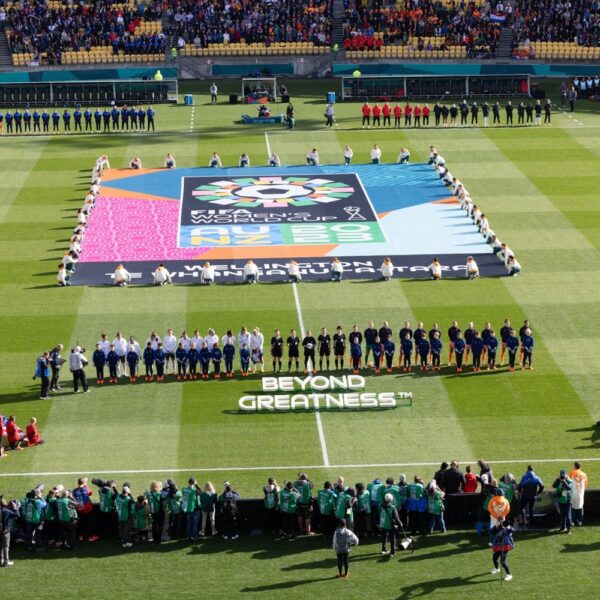
When FIFA confirmed that the Women’s World Cup would grow from 24 teams to 32 in 2023, the expansion was widely welcomed. But it also prompted concerns about competitive balance.
Thirty-two teams meant eight debutants and a wider qualification funnel drawing sides from every corner of the women’s game. Some came from established professional systems. Others were still fighting for the investment and infrastructure their rivals took for granted.
The concern was straightforward: would a bigger tournament produce more one-sided matches and expose the gap between the strongest and weakest nations?
It did not.
Instead, the biggest Women’s World Cup in history became the most competitive yet.
FIFA’s Technical Study Group, led by two-time World Cup-winning coach Jill Ellis, compared the 2023 tournament in Australia and New Zealand with the previous two editions. Its conclusion was striking: despite expanding from 24 to 32 teams, the competition was more closely contested than either France 2019 or Canada 2015.
Ellis described the progress of emerging nations as one of the tournament’s biggest success stories, with the gap to the established teams beginning to close. In a separate FIFA Training Centre interview, she also examined some of the changes behind that shift.
That is the real expansion paradox. Not that adding teams somehow created competitiveness, but that expansion revealed how much the wider women’s game had already improved.
The numbers tell a different story
The statistics challenge the idea that an expanded World Cup would inevitably bring more heavy defeats.
According to FIFA’s post-tournament analysis, goals per game fell to 2.56 from 2.81 at both of the previous two editions. That was a decline of around nine per cent despite the expanded competition adding 12 matches. The group stage was even more revealing, averaging 2.65 goals per game, 12 per cent lower than in 2015.
Clean sheets increased by 14 per cent compared with the 2015 tournament, while FIFA’s tournament recap recorded that 43 per cent of all team performances ended without conceding a goal. There were also ten goalless draws in Australia and New Zealand, more than the 2015 and 2019 tournaments combined.
A larger field had not produced a procession of mismatches. If anything, many teams were becoming harder to break down.
When the established order broke
The results told the same story.
Germany arrived ranked second in the world by FIFA and as runners-up at the previous year’s European Championship. They left after the group stage for the first time in nine Women’s World Cup appearances.
A 2-1 defeat by Colombia was followed by a 1-1 draw with South Korea, ending the campaign of one of the pre-tournament favourites.
Jamaica held Brazil to a goalless draw to reach the last 16 and send the South Americans home in the group stage for the first time since 1995.
Morocco provided an even more dramatic example. After losing their opening match 6-0 to Germany, they responded with consecutive 1-0 victories over South Korea and Colombia. They became the lowest-ranked nation to reach the knockout stage of a Women’s World Cup.
South Africa also reached the knockout rounds after a stoppage-time winner against Italy. The remarkable group-stage exits and breakthroughs were covered in this Associated Press report carried by TSN.
Even the defending champions did not survive the first knockout round. The United States were eliminated by Sweden on penalties in the last 16.
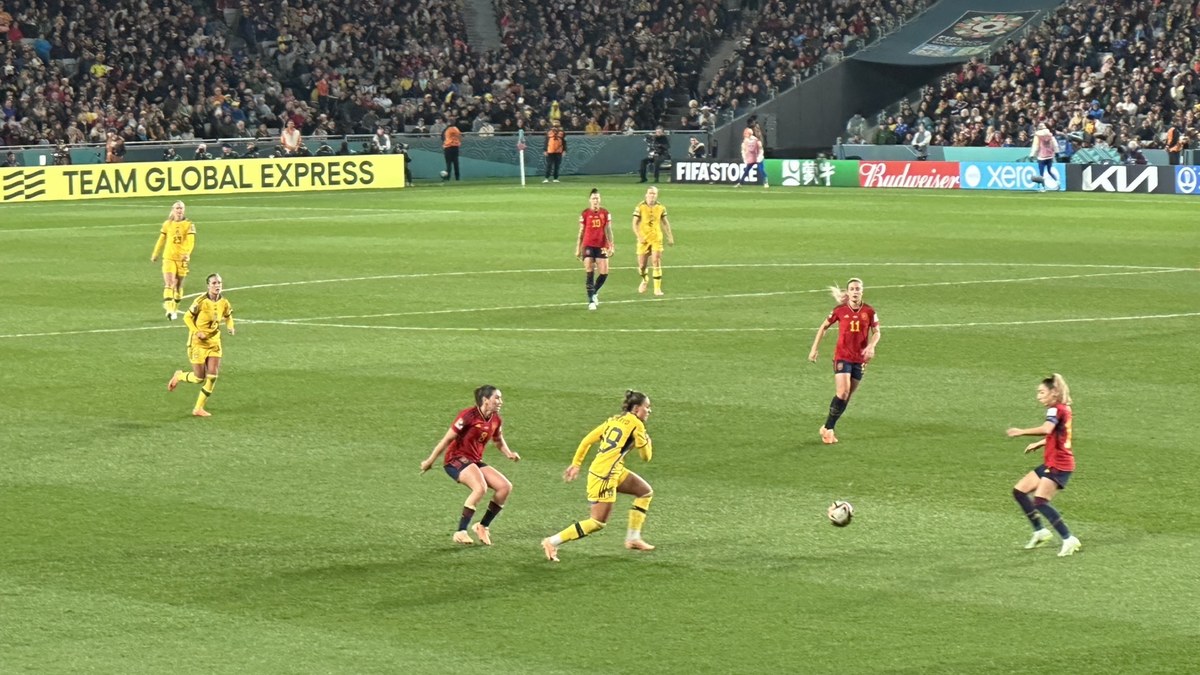
Spain eventually beat England 1-0 in the final to become champions for the first time. Nine editions of the Women’s World Cup have now produced five different winners.
The important point is not simply that there were upsets. It is that several of them came from teams showing organisation, tactical discipline and an ability to manage matches that had not always been associated with nations outside the traditional elite.
Credit: Wendy Harman / CC BY 2.0 / cropped
Why did the gap narrow?
It would be tempting to credit expansion itself with making the tournament less predictable. That would confuse cause and effect.
Adding eight teams did not make everyone better. The tournament became more competitive because more teams were already better equipped to compete, and the expanded format gave them a bigger stage on which to demonstrate it.
FIFA’s analysts identified defensive organisation as one of the defining features of the tournament.
Teams played in tighter blocks, pressed with greater discipline and managed games more effectively. Technical Study Group member Chan Yuen Ting highlighted the organisation of the debutants in particular, describing them as competitive sides with strong defensive structures in FIFA’s technical review.
Goalkeeping standards also improved, making chances harder to convert and reducing the space stronger attacking teams could exploit.
Set pieces became another important part of the contest. FIFA recorded 34 goals from set plays, while finalists Spain and England both completed the tournament without conceding from one.
Those are small margins, but tournaments are increasingly decided by them.
Ellis connected the tactical changes with something more fundamental: the continuing professionalisation of women’s football.
As more players gain regular experience in professional leagues and high-level training environments, tactical standards rise with them. National teams can defend in different shapes, change their approach during matches and arrive at tournaments better prepared for a wider range of opponents.
FIFA also reported that 84 per cent of named squad players appeared during the 2023 tournament, compared with 80 per cent in 2019. That figure needs treating cautiously. Five substitutions were available for the first time and FIFA found no direct relationship between the number of players used and how far a team progressed.
It nevertheless forms part of a wider picture of a tournament played by a growing pool of players exposed to increasingly professional international and club environments.
A genuinely global competition
There is another measure of how the balance shifted.
When FIFA approved the expansion of the Women’s World Cup to 48 teams from 2031, president Gianni Infantino pointed to two features of the 2023 tournament. As Reuters reported when the expansion was confirmed, it was the first Women’s World Cup at which teams from every confederation won at least one match, and the first in which teams from five confederations reached the knockout stage.
For much of the competition’s history, the latter stages had been dominated by a relatively small group of established nations.
Australia and New Zealand showed a broader picture.
The traditional powers had not disappeared and many still went deep into the tournament. But simply arriving with a superior historical record, higher ranking or more recognisable players was no longer enough to guarantee progress.
That is a healthier definition of a World Cup. More countries were not merely participating. They were affecting the competition.
What 2023 tells us about Brazil 2027
Brazil 2027 will be the second and final 32-team Women’s World Cup before the competition expands again to 48 nations in 2031.
The obvious lesson from 2023 is that the assumption that expansion must automatically weaken competitive balance deserves to be challenged.
The concern ahead of Australia and New Zealand was testable: adding eight teams might produce weaker opposition and more one-sided matches. The tournament did not follow that pattern.
But moving from 24 to 32 teams does not prove that an increase from 32 to 48 will have the same effect.
That will be another test entirely. Sixteen additional places will reach deeper into the international game, and legitimate questions remain about whether every confederation can provide that extra depth without increasing the number of mismatches.
What 2023 does provide is a warning against assuming the answer in advance.
The wider trend is towards stronger defensive organisation, better coaching, increased professionalisation and more international players operating in demanding club environments.
The floor of the women’s international game has risen.
Malawi show the shift is continuing
Eighteen nations have now secured places at Brazil 2027, leaving 14 positions still to be filled.
Africa has provided another indication that the established order cannot be taken for granted.
Algeria and Malawi have both qualified for a Women’s World Cup for the first time.
Malawi’s story is particularly striking. Ranked 153rd in the world, they reached the Women’s Africa Cup of Nations final on their tournament debut, having beaten Ghana in the quarter-finals.
Cameroon eventually defeated Malawi 3-0 in the final, but they had already secured a first appearance on the global stage.
At the other end of the spectrum, ten-time African champions Nigeria will not be in Brazil. Cameroon ended their WAFCON title defence, but Nigeria still had a route to the World Cup through the qualification play-offs. A subsequent 2-1 defeat by South Africa finally ended their campaign.
It is another reminder that reputation is becoming less reliable as a guide to what happens on the pitch.
Spain will arrive in Brazil as defending champions. The United States will be trying to recover from their earliest World Cup exit. Established European and Asian powers will expect to challenge again.
But 2023 showed that the conversation can no longer stop with the familiar names.
The expansion paradox was never really about expansion. It was about a tournament revealing how much of the world had caught up while attention was focused elsewhere.
Brazil 2027 will tell us whether that process has continued.