

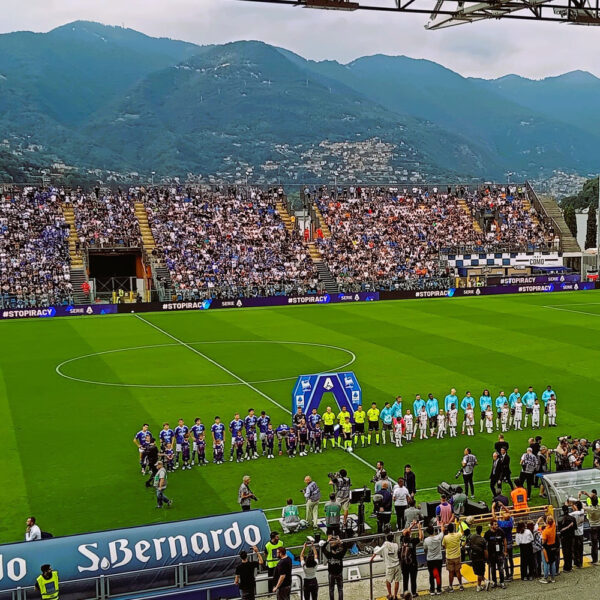

The ninth goal in Lens came from an 18-year-old who had grown up in Como’s academy. Matteo Papaccioli collected Mattia Liberali’s pass and scored in stoppage time, adding his name to a night dominated by Tasos Douvikas and Nico Paz.
For football fans largely focused on Como’s billionaire owners, celebrity connections and luxury positioning, it was a wonderfully inconvenient detail.
Como had just won 9–1 away in the Champions League. UEFA confirmed it as the competition’s biggest away victory, matching the eight-goal margins Liverpool and Real Madrid had achieved at home. A project associated with lake views and fashion partnerships had produced a historic result.
Yet the football and the commercial ambition cannot be separated neatly. The team gives the business credibility; the owners’ money gives the team possibilities. Whether that relationship can become durable is the real question.
I write as a supporter who grew up following the club from Brooklyn. International interest is something I welcome. But the distinction between making Como accessible to the world and making it less accessible to Como matters enormously.
A club with history, backed by money that changes the odds
“Small club” can describe a catchment area, a stadium, a trophy cabinet or a balance sheet. In Como’s case, those measures increasingly point in different directions.
Founded in 1907, the club existed long before its current owners or its global ambitions. Its recent past includes bankruptcy, failed attempts at recovery and a restart in Serie D in 2017. SENT Entertainment acquired the club in April 2019, with the backing of Indonesia’s Hartono family. Promotion to Serie C followed that spring, Serie B in 2021 and Serie A in 2024.
For long-time supporters who have watched the club struggle to survive, financial backing buys more than exciting transfers. It buys stability and a bright outlook.
Como are geographically modest, but they are not powerless. Their rise should not be packaged as a rags-to-riches story. The town itself is rich. The club owners have supplied exceptional means to challenge the Serie A establishment.
That does not invalidate the achievement. Money can assemble an expensive squad that plays badly, and has, many times.
Selling a place that the world already knows
The owners have one asset that cannot be reproduced through recruitment: Lake Como already occupies a prominent place in the international imagination.
Most clubs seeking overseas supporters must first explain where they come from. Como can approach people who know the destination but have never thought about its football team. A visitor might discover the club while booking a holiday; a football supporter might discover the city through a televised match. Both are potential customers for something beyond a ticket.
The Financial Times examined these ambitions earlier this year in “Balls, boats and billionaires”, describing Como’s attempt to develop a lifestyle business alongside the team. The club’s own activity makes that intention explicit. Its launch of SENT Tourism advertised match packages, hospitality, cultural visits and private lake experiences for supporters and corporate clients.
Fashion is another entry point. Chief Brand Officer Rhuigi Villaseñor worked with adidas on the 2026/27 home shirt; Brioni has supplied formalwear. These products can reach yet another class of potential fans.
The commercial logic is undeniable. A stadium seat can only be sold for a particular event. Clothing, travel and hospitality create other opportunities to earn from the same name, including during periods without home fixtures.
But a purchase is not necessarily an allegiance. Someone can like a shirt without caring about the team’s next result. A traveller can enjoy a match and never return. The challenge is converting curiosity into a relationship that survives bad results.
Como have attracted attention through a familiar place and recognisable personalities. The challenge is keeping that attention when the novelty wears off.
The football has to justify the invitation
Cesc Fàbregas is central to that task. His playing career made him an internationally recognisable figure before he became a head coach. At Como, that recognition now introduces people to a team with an identifiable approach.
His players invite pressure, look for combinations through midfield and commit runners ahead of the ball. The attraction is visible in the relationship between Paz and Douvikas: one searches for the passing angle, the other gives the pass somewhere to go. Full-backs and supporting midfielders make it difficult to solve the attack simply by surrounding the most talented player.
This matters commercially because attractive football gives unfamiliar viewers a reason to watch twice. The first encounter may come through Fàbregas’s name. The second comes because they want to watch Paz again.
The domestic evidence also deserves attention alongside the extraordinary European scorelines. After 11 Serie A games, Como statistics show seven wins, two draws and two defeats, with 18 goals against 18.30 expected goals. Douvikas leads their league scoring with five; Paz leads the team with 19 key passes.
That snapshot is useful precisely because it is less spectacular than nine goals in France. Como’s league scoring is broadly in line with the quality of chances recorded by that model. It suggests their attacking return does not depend on reproducing the exceptional finishing of one European evening. Eleven matches remain a limited sample, and expected goals cannot certify a project’s future, but the numbers give substance to the excitement.
For many fans, the question is whether this can outlast Fàbregas. A coach who connects recruitment, player development and public identity becomes difficult to replace. Como’s 2024 appointment announcement also gave Osian Roberts responsibility for development and coach education, an indication that the intended structure extends beyond the first-team bench.
That structure will matter when a leading player leaves, a coach is approached or a season turns difficult. A durable club must preserve its fundamental structure when coaches or players move on.
The accounts are still those of an investment project
Commercial ambition should not be confused with demonstrated financial independence.
In April 2026, La Gazzetta dello Sport’s analysis of the 2024/25 accounts distinguished between a loss of approximately €105 million at club level and about €132 million in the wider pro-forma consolidated group. These are different accounting scopes, not figures to add together. Excluding player trading, the report put revenue at roughly €48 million for the club and €55 million for the group.
Those accounts concern the 2024/25 season, not the current campaign. Nevertheless, they show how far commercial development still has to travel. The wider businesses are incurring costs as well as generating income; diversification has not yet made the project self-financing.
The test is what happens when the next recruitment decision is uncomfortable. Can Como replace a departing player without requiring another exceptional injection from the owners? Can they maintain facilities, staff and academy investment if they miss European qualification? Can income from outside football materially help, rather than merely add another set of costs?
A luxury business might eventually make those decisions easier. It cannot be assumed to do so simply because its products are expensive. Sales, profit and money available to the football operation are three different things.
There is also a risk of calling revenue “diversified” when its sources depend on the same good news. Shirts, premium packages and sponsorship may all benefit from Champions League exposure. If they all weaken after a poor season, they provide less protection than the range of products initially suggests.
The owners’ commitment has given Como time to pursue an ambitious model. Whether that model can eventually reduce the need for their continued support remains an open question.
How Italian does an Italian club need to be?
The squad’s international composition has become another argument about what Como are becoming.
The concern has a factual basis. Their starting side at Lens contained no Italian players. Yet the claim that Italian players have disappeared altogether cannot survive the same evening: Samuele Ricci came off the bench, Liberali scored, and young Papaccioli supplied the final goal.
Nationality, local attachment and opportunity are related questions, but they are not interchangeable. An Italian signing from Rome, for example, is not automatically a stronger connection to Como than a Greek player who spends years there. Conversely, dismissing every concern about Italian minutes as nostalgia ignores a legitimate question about the route from youth football to the first team.
Supporters have asked a legitimate question: whether a talented youngster can progress through the ranks to win a first-team place.
Fàbregas has pointed to the academy in answering criticism. Following the Youth League victory over Manchester United in October, he highlighted a starting XI containing eight Italians. That is relevant evidence of activity below the first team. Papaccioli’s European debut offers a tangible example of progression.
Neither settles the matter entirely. A goal with a match already won is a memorable beginning; sustained opportunity means selection when places are contested and points are at risk. The useful measure will be meaningful minutes across several seasons, alongside the quality of coaching and the careers of those who develop through the system.
Como need not abandon international recruitment to meet that standard. They need the academy to be part of how the team improves, with success measured beyond the occasional photograph of a promising teenager beside Fàbregas.
The people who cannot simply choose another club
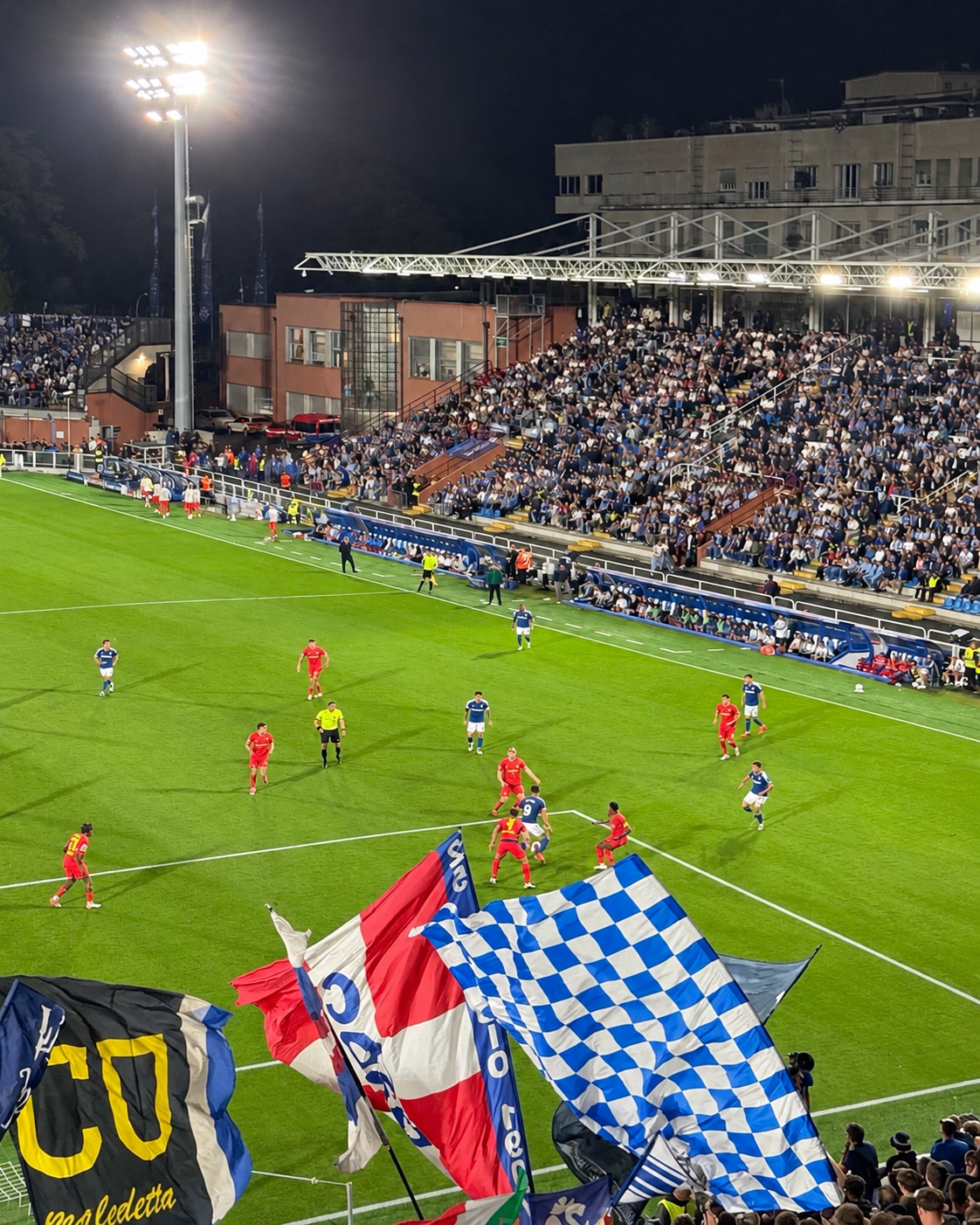
Richibrics · CC BY-SA 4.0 · Cropped

Commercial growth becomes most sensitive when it reaches the match-going supporter.
An overseas customer can decide that a package is too expensive and book another destination. A lifelong supporter has a different relationship with the product. The ability to attend is part of their connection to family, friends and place. That gives a club responsibilities beyond ordinary customer acquisition.
It would be unfair to imply that Como have made no effort locally. The club’s Vicini di Casa initiative offered eligible residents near the stadium complimentary tickets, subject to availability, during 2025/26. Its stadium redevelopment announcement also committed to engagement with supporters and residents.
The larger questions remain practical. Are ordinary tickets accessible? Can families attend regularly? Do residents have a meaningful voice in changes around the ground? Does redevelopment improve the local supporter experience?
A luxury visitor and a local season-ticket holder can coexist happily. The difficulty arises when the latter becomes less important to decision-making because the former spends more per visit.
As an overseas supporter, I have little interest in policing where someone must live to belong, but I also don’t want to be in a bidding war with a 70-year-old local supporter when I buy tickets.
What the rest of football can learn
Como offer an intriguing example of what happens when wealthy ownership has a coherent sporting direction and a feasible commercial model. It’s not a formula that every struggling club can copy. Most cannot summon either the capital or the destination.
The transferable lesson is to build around something specific and credible. Como’s location supports its ambitions. Its football supports its growing audience. Its academy can supply a connection between the city and the team that no commercial partnership can provide on its own.
The danger is allowing the easiest things to measure to stand in for the hardest. Revenue does not fully measure attachment. Followers do not measure loyalty. A global audience does not prove that a local institution is healthy.
Can Como become a global football brand? The evidence increasingly suggests they can. The more consequential question is what kind of club will sit beneath that brand when the current rush of attention subsides.
The night in Lens offered an overwhelmingly hopeful answer. Among the internationally recruited stars stood a teenager from the academy, waiting for confirmation that his goal counted. The score was 9–1 at that moment. An older supporter I know exclaimed: “That’s more like it.”