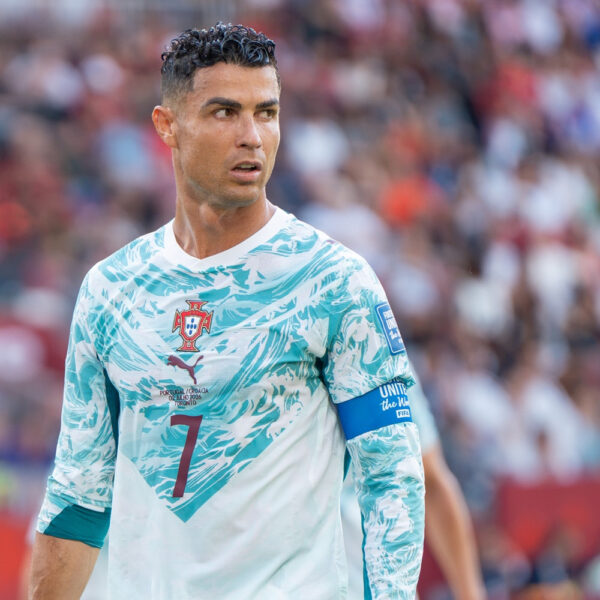
Cristiano Ronaldo has announced his retirement from international football, bringing an end to a 23-year Portugal career in which he became the most-capped and highest-scoring men’s international player in history.
The 41-year-old leaves the national side with 234 appearances and 146 goals, as well as a European Championship title and two Nations League trophies. He confirmed his decision on Thursday in a video shared on social media, telling Portuguese supporters that the time had come to pass on the No 7 shirt.
It is the end of an extraordinary international career, although the circumstances of his departure have been far from straightforward.
Twenty-three years in a Portugal shirt
Ronaldo made his senior Portugal debut against Kazakhstan in August 2003, coming on for Luís Figo at half-time. He went on to represent his country at six European Championships and six World Cups, a span of major tournaments almost impossible to imagine when he first appeared as an 18-year-old.
His first European Championship ended in disappointment when Portugal lost the 2004 final to Greece on home soil. Twelve years later came the achievement that had eluded generations of Portuguese players: victory at Euro 2016. Ronaldo was forced off injured during the final against France, but Portugal went on to win through Éder’s extra-time goal.
Further international trophies followed in the Nations League in 2019 and 2025. The figures confirmed by FIFA are remarkable in their own right: 234 caps, 146 goals and goals at six different World Cups. He scored three times at the 2026 tournament, which ended for Portugal with a last-16 defeat by Spain.
Those numbers describe his consistency, but not the whole of his contribution. Ronaldo developed from a young wide player into a prolific goalscorer and remained a central figure as Portugal moved through several generations of footballers. His place in the country’s football history rests on what the team won as well as what he achieved individually.
A difficult final chapter
There is no disguising the disagreement that preceded Thursday’s announcement. Ronaldo’s relationship with Portugal manager Jorge Jesus deteriorated during the September international break after he remained on the bench against Norway.
Ronaldo subsequently left the national team camp ahead of the match against Denmark. He said Jesus had failed to honour an agreement over his playing time. The manager disputed that account. Ronaldo later apologised for his conduct and said he still wanted to be available for selection, but the Portuguese Football Federation imposed a 30-day suspension and a fine.
His decision to retire has now followed that episode. It would, however, be unfair to present the dispute as the sole explanation for a decision that Ronaldo himself described as emotional and difficult. His farewell message concentrated on his connection to Portugal, the people he played alongside and the supporters who followed him.
Ronaldo’s own farewell message
In the video, Ronaldo reflected on the responsibility of wearing Portugal’s No 7 shirt and thanked those who had shared the journey. His message was accompanied by a simple promise: “Portugal will always be in me.”
Portugal estará sempre em mim.
— Cristiano Ronaldo (@Cristiano) 5 November 2026
Watch Ronaldo’s full retirement announcement on Instagram.
What comes next for Portugal?
The Portuguese Football Federation has said it wants to organise a proper tribute to a player who helped change the national team’s standing in world football. His international retirement does not mean the end of his playing career: he is continuing at club level with Al Nassr.
Portugal must now plan for a future without a player whose presence has been almost constant since 2003. That transition was always coming, even if the timing and circumstances have proved uncomfortable.
Ronaldo’s final months with the national side will remain part of the story. They should not obscure the larger one: 23 years, three international trophies and records that may stand for a very long time.