In the 1990s, a typical side in Europe’s five biggest leagues was a different team at home. Take a 38-match season as an illustration. Over its 19 home games it would collect about 33 points. From its 19 away games it would bring back about 19. That is a difference of 14 points, or 0.73 points per match.
Using the averages from the five seasons to 2025/26, the same calculation gives about 30 points at home and 22 or 23 away. The gap is about seven points, or 0.37 per match.
Playing at home still helps. It just helps about half as much as it did a generation ago.
What the numbers say
I looked at 59,079 league matches across 33 seasons in the Premier League, La Liga, Serie A, the Bundesliga and Ligue 1, from 1993/94 to 2025/26. For each period I compared what home and away sides collected per match, counting three points for a win and one for a draw throughout.
Home sides averaged 1.72 points per match in the 1990s and 1.56 in the last five seasons. Away sides went from 0.99 to 1.19. Both halves of the gap moved, and the visitors’ gain was slightly the larger.
The goals tell a clearer story. Home teams scored 1.57 goals per match in the 1990s and 1.55 in the most recent five seasons. Away teams went from 1.05 to 1.26, an increase of about 20%.
Results have shifted with it. In the 1990s there were two home wins for every away win (47.9% of matches against 23.6%). Now it is 43.5% against 31.1%, roughly seven home wins for every five away. Draws have become rarer too, falling from 28.5% to 25.4%.
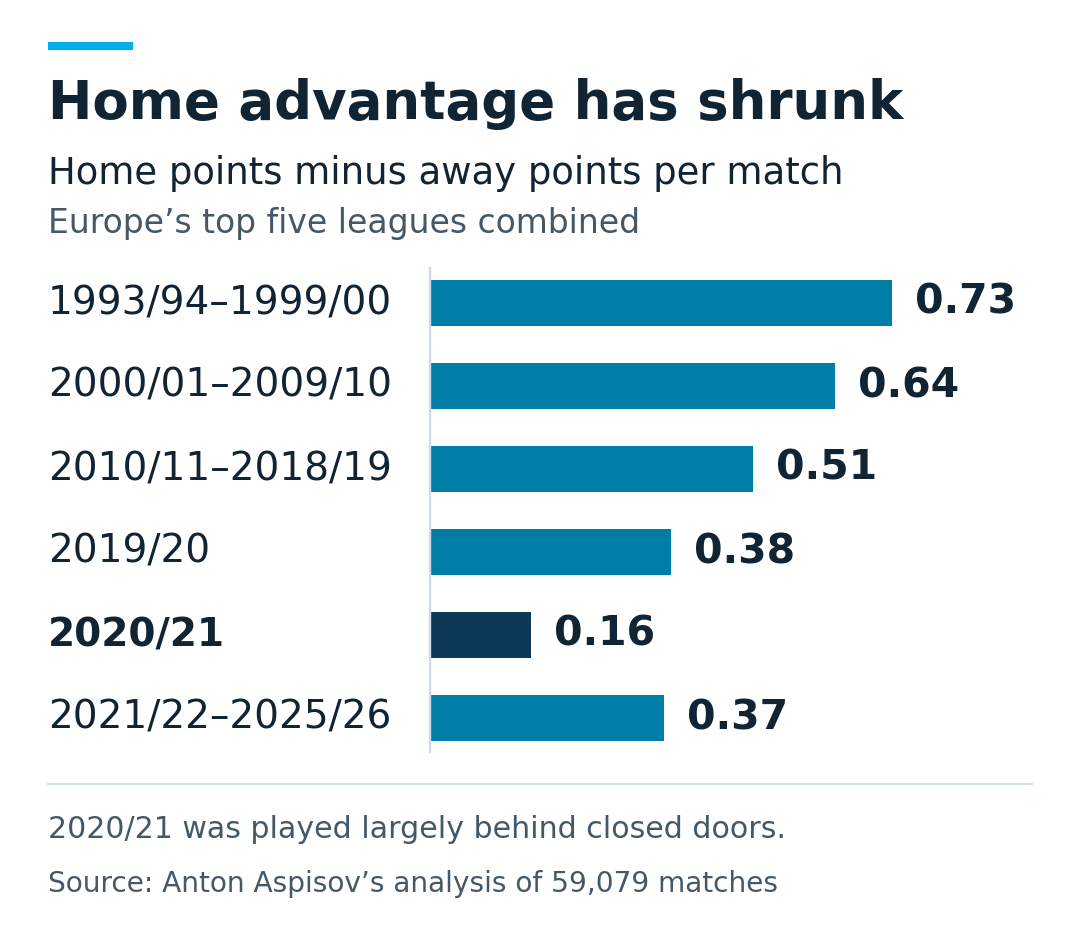
Table 1. Home and away results across five leagues
| Period | Matches | Home pts/game | Away pts/game | Points gap | Home goals/game | Away goals/game | Home wins | Draws | Away wins |
|---|---|---|---|---|---|---|---|---|---|
| 1993/94 to 1999/00 | 12,370 | 1.72 | 0.99 | 0.73 | 1.57 | 1.05 | 47.9% | 28.5% | 23.6% |
| 2000/01 to 2009/10 | 17,816 | 1.68 | 1.05 | 0.64 | 1.51 | 1.08 | 47.2% | 26.9% | 25.9% |
| 2010/11 to 2018/19 | 16,434 | 1.63 | 1.12 | 0.51 | 1.55 | 1.17 | 45.9% | 25.3% | 28.8% |
| 2019/20 | 1,725 | 1.57 | 1.19 | 0.38 | 1.54 | 1.25 | 44.1% | 24.3% | 31.5% |
| 2020/21 | 1,826 | 1.45 | 1.29 | 0.16 | 1.48 | 1.32 | 39.9% | 25.4% | 34.7% |
| 2021/22 to 2025/26 | 8,908 | 1.56 | 1.19 | 0.37 | 1.55 | 1.26 | 43.5% | 25.4% | 31.1% |
Points gaps are calculated before rounding and may differ by 0.01 from the difference between the displayed averages. The date ranges show how many seasons each period covers.
The gap was already falling before the pandemic. It went from 0.73 in the 1990s to 0.64 in the 2000s and 0.51 in the nine seasons to 2018/19.
Football behind closed doors
The 2020/21 season, played largely behind closed doors, was the low point of the series. The gap fell to 0.16, and home sides won fewer than four matches in ten. In two leagues visitors won more often than hosts. The Premier League had 153 away wins to 144 home wins, and Ligue 1 had 143 to 142. Those were the only two instances in the sample.
Most of 2019/20 was played with crowds. Four leagues finished behind closed doors, while Ligue 1 stopped after 279 of its scheduled 380 matches. Across the four leagues that resumed, the gap was 0.38 in the 1,038 matches before the March stoppage and 0.19 in the 408 after the restart. Those 408 matches comprised 92 in the Premier League, 110 in La Liga, 124 in Serie A and 82 in the Bundesliga.
In that shorter run of matches, the Bundesliga swung towards the away teams, from a gap of 0.25 to −0.40, and La Liga fell from 0.70 to 0.27. The Premier League barely changed, from 0.44 to 0.46, and Serie A rose from 0.09 to 0.31. Across the five seasons from 2021/22 to 2025/26, the combined gap recovered to 0.37, close to the 2019/20 figure of 0.38.
Some leagues are changing faster than others
Table 2. Home minus away points per match by league
| League | 1993/94 to 1999/00 | 2000/01 to 2009/10 | 2010/11 to 2018/19 | 2019/20 | 2020/21 | 2021/22 to 2025/26 |
|---|---|---|---|---|---|---|
| Premier League | 0.57 | 0.60 | 0.49 | 0.44 | −0.07 | 0.37 |
| La Liga | 0.71 | 0.64 | 0.58 | 0.58 | 0.36 | 0.53 |
| Serie A | 0.85 | 0.65 | 0.49 | 0.17 | 0.22 | 0.24 |
| Bundesliga | 0.68 | 0.60 | 0.48 | 0.08 | 0.32 | 0.39 |
| Ligue 1 | 0.87 | 0.70 | 0.53 | 0.63* | −0.01 | 0.34 |
| Five leagues | 0.73 | 0.64 | 0.51 | 0.38 | 0.16 | 0.37 |
* Ligue 1’s 2019/20 season ended after 279 of its scheduled 380 matches.
Home advantage fell in all five leagues between the 1990s and the most recent five seasons.
Italy and France have changed most. In the 1990s they were the hardest places in this group to go and win: visitors took only about one match in five (21% in both). Now they take about one in three (32% in both). Ligue 1’s away sides used to score 0.89 goals per match and now score 1.28, the biggest rise anywhere.
Serie A is the one league where the hosts themselves have clearly faded. Home goals there have dropped from 1.59 per match to 1.39, while away goals rose from 1.01 to 1.21. Home wins have gone from half of all matches to 40%. Its gap of 0.24 is the smallest of the five and has hardly moved since the empty-stadium season (0.22).
La Liga is the opposite case. Its gap of 0.53 is close to where it stood in the 2010s, and more than double Serie A’s. Home sides still win 45.7% of matches there and away sides 28.1%. Spanish away teams score barely more than in the 1990s (1.12 against 1.06).
The Premier League had the smallest gap of the five in the 1990s (0.57) and has moved less than most. Its home win rate has hardly changed, from 45.5% then to 44.2% in the most recent five seasons. Away wins became more common and draws less frequent. The Premier League (0.37), the Bundesliga (0.39) and Ligue 1 (0.34) now sit close together.
Why Spain has held on to home advantage while Italy has lost most of it is the most interesting question these tables raise. They cannot answer it.
What might be behind it
Empty stands. Home advantage hit its lowest point in 2020/21 and rose again after supporters returned. That is consistent with crowds playing a part. Other things changed too, including fixture congestion and a shorter pre-season. With final scores and no attendance data, this analysis cannot isolate the effect of crowds. The points gap had already been falling for years before the pandemic.
Bolder away sides. Away teams now score about a fifth more goals and fewer games end in draws. Three points for a win may give visitors more reason to go after a victory, although England adopted the rule well before the start of the period studied and other leagues did so early in the period. The points gap kept narrowing for decades afterwards. The scores alone cannot tell us whether teams changed their approach.
Refereeing and video review. A common argument is that referees once leaned towards the home side and that closer scrutiny has reduced it. This analysis uses final scores only. It contains nothing on penalties, cards or reviewed decisions, so it can neither support nor contradict that.
Travel, preparation and resources. Easier journeys, better recovery and more professional planning may all have made away days less of a handicap. Nothing here measures them.
How this was calculated
- Matches. Top-flight league fixtures from 1993/94 to 2025/26. The analysis uses the matches recorded in Ligue 1’s curtailed 2019/20 season and excludes cups, play-offs and European games.
- Points. Three points for a win and one for a draw are applied to every season, including seasons when some leagues awarded two points for a win. The gap is home points per match minus away points per match.
- Sources. Footballcsv’s England and Germany datasets (CC0) cover the Premier League and Bundesliga from 1993/94 to 2009/10. Openfootball (CC0) covers those leagues from 2010/11, La Liga from 2012/13, Serie A from 2013/14 and Ligue 1 from 2014/15. Earlier scores come from the results grids on English Wikipedia season pages (CC BY-SA 4.0): La Liga 1993/94–2011/12, Serie A 1993/94–2012/13 and the French top flight 1993/94–2013/14. Match counts were checked against each season’s league format.
- Exceptional results. Verona v Roma in 2020/21 is recorded as an awarded 3–0 home win. Bastia v Lyon in 2016/17 counts as an awarded away win, with the goals recorded as 0–0. The abandoned Nantes v Toulouse match in 2025/26 counts as a draw after the French league confirmed the 0–0 score.
- Limits. These are descriptive averages. The analysis does not adjust for team strength and contains no attendance data. A single league season can fluctuate considerably.
The short version
In a 38-match season, the average difference between home and away points has gone from about 14 to seven. Across the five leagues, visitors score more and win more often than they did in the 1990s. In the five seasons to 2025/26, the home points gap in Spain was still more than twice the size of Italy’s.