
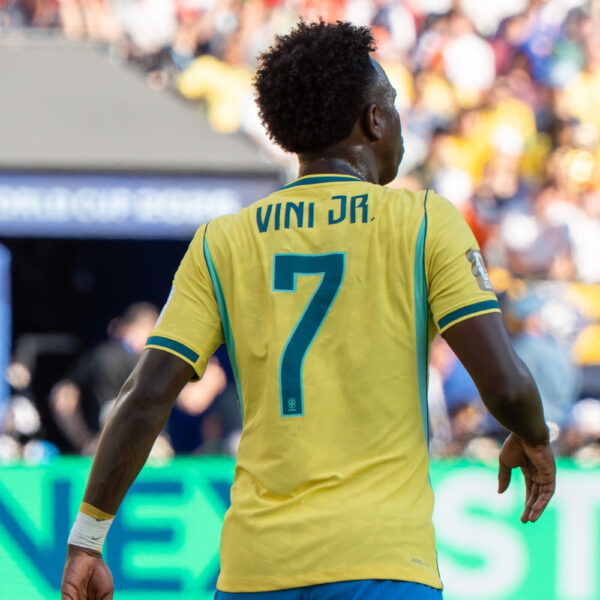
Real Madrid star Vinícius Júnior has sent a personal video message to a 13-year-old Sudanese boy who lost both legs in a drone strike, inviting him to attend a match in Madrid and spend the day together.
The Brazilian international reached out after learning about Zaher, a young football supporter whose life was devastated by Sudan’s civil war. Following months of specialist treatment in Egypt, Zaher has learned to walk using prosthetic legs and can now kick a football again.
For Zaher, however, the dream that began his recovery was much closer to home. He simply wanted to play football with his friends again.
The story was first reported by BBC News, whose latest coverage on Wednesday included footage of Zaher’s emotional reaction to a surprise message from his favourite footballer.
Watch: Vinícius Júnior’s surprise message to Zaher
Video: BBC News.
Vinícius Júnior’s invitation to Madrid
The BBC first met Zaher in Khartoum in 2025, a year after a drone strike left him with injuries that required both legs to be amputated below the knee.
At the time, he was using a wheelchair to get around his devastated neighbourhood and sometimes playing football on his knees, despite the pain and risk of infection.
His ambition was to receive prosthetic legs so he could walk, return to school and enjoy football with his friends.
When the BBC discovered that Vinícius Júnior was his favourite player, journalists contacted Real Madrid. The Brazilian winger agreed to record a personal message of encouragement.
After praising Zaher’s determination and expressing his hope that he would return to playing football, Vinícius delivered an unexpected invitation.
“I would like to invite you to attend a Madrid match. We can spend the day together.”
Zaher was visibly overwhelmed. He briefly left the room before returning wearing a shirt bearing Vinícius’s name.
“His message has really uplifted me,” he told the BBC.
He now hopes to obtain a visa so he can travel to Spain and meet his hero. No date for the proposed visit has yet been announced.
How Zaher found his way back to football
Zaher’s recovery has been made possible by an international fundraising campaign launched after his story first appeared on the BBC.
Dena Latif, a UK-based lawyer of Sudanese heritage, helped raise £45,000 towards his medical treatment after being moved by his circumstances.
Zaher and his mother, Habibah, travelled to Cairo, where he underwent further surgery and months of rehabilitation. He also received psychological support following his experiences during the war.
His doctors have described a striking change in his confidence. Once withdrawn and struggling to cope with his injuries, Zaher is now walking, laughing and looking forward to trying new activities.
He has even expressed an ambition to become an airline pilot.
Football, though, remains an important part of his life. He can now kick a ball with his prosthetic legs, although he had not yet returned to playing a proper match with his friends when the BBC caught up with him.
For Zaher, being able to play football again means getting back something the war took away. Across Sudan, other children are finding similar opportunities to play, even as the conflict continues to disrupt their lives.
Why football matters to children caught up in Sudan’s war
For many children in Sudan, the opportunity to play football has become something they can no longer take for granted.
The conflict, which began in April 2023, has disrupted education, displaced families and destroyed neighbourhoods, including the places where children once gathered to play.
Yet football continues to provide opportunities for friendship and recreation, even in extremely difficult circumstances.
In June 2026, UNICEF reported on a child-friendly centre at Alkashafa camp in Sudan’s White Nile State, where football is among the activities helping children affected by conflict and displacement.
The centre welcomes around 150 children each day, many of whom are out of school. Alongside educational activities and psychological support, children can take part in organised games.
UNICEF described two young football captains, 13-year-old Al Mishal and 14-year-old Butros, leading opposing teams in matches supported by the centre’s recreational programme.
For children whose everyday lives have been disrupted, these games offer opportunities to build friendships, develop confidence and spend time with others their own age.
Zaher is not the only young football supporter in Sudan trying to rebuild his life after suffering devastating injuries.
In January, UNICEF reported the story of Hussein, an 11-year-old boy in Khartoum who had lost a leg during the war but retained his love of football.
Hussein was attending a digital learning centre established to help children whose education had been interrupted by the conflict.
Both stories demonstrate how much ordinary childhood activities can matter when so much else has been taken away.
A future beyond the Real Madrid invitation
According to UNICEF’s August 2026 humanitarian report, 17.3 million children in Sudan need humanitarian assistance.
For children who have sustained serious injuries, access to surgery is only part of the challenge. Rehabilitation, education and continued medical care can be essential to their future independence.
Children who use prosthetic limbs also require regular assessment and adjustments as they grow.
Zaher and his mother have now returned to Khartoum, where they hope his prosthetic legs can be maintained and adjusted locally.
His recovery has been an extraordinary achievement, made possible by the generosity of people who responded to his circumstances and the medical professionals who helped him.
Vinícius Júnior’s message has given him another reason to smile. The footballer deserves credit for taking the time to respond personally and offering an experience Zaher is unlikely to forget.
It has also brought renewed attention to a conflict in which millions of children continue to face hardship, injury and displacement.
Hopefully, Zaher will get his day at the Bernabéu and the chance to meet Vinícius Júnior.
But there is another football occasion worth hoping for, one without a famous player or thousands of spectators.
Just Zaher, his friends and a football, playing together again in Khartoum.